
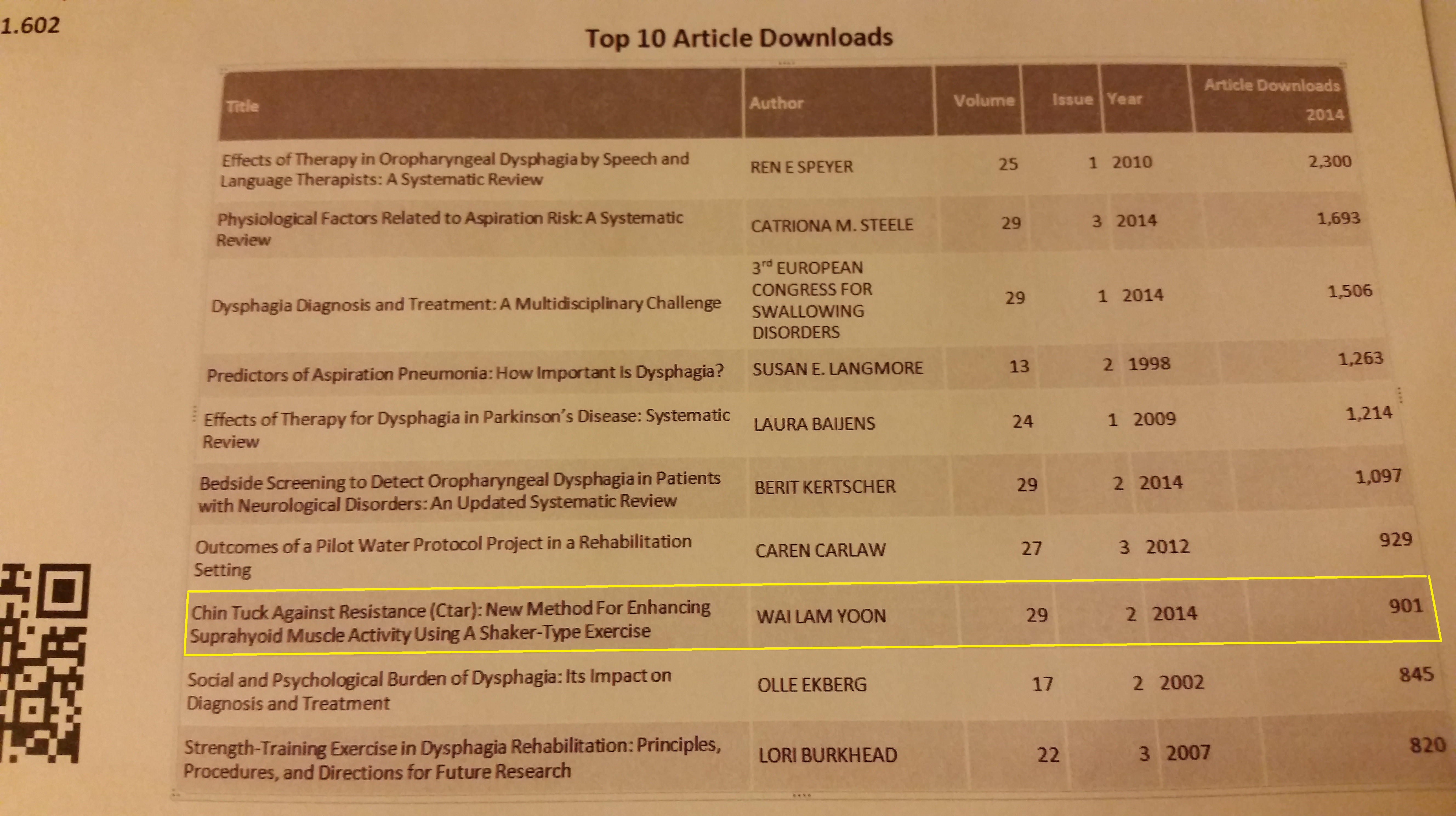
Chin Tuck Against Resistance (CTAR) is the top 10 most downloaded article from the Dysphagia Journal in 2014
I would like to take this opportunity to thank Speech-Language Pathologists / Therapists around the world for all the interest, support and word of encouragement for the Chin Tuck Against Resistance (CTAR) exercise and researches.
The National University of Singapore MSc SLP team will continue to try our best to come out with more quality researches.
The surprise news came from Mr Sze Wei Ping (A MSc graduate from National University of Singapore) 2 weeks ago when he went to present the follow up study on CTAR at the 23rd Dysphagia Research Meeting at Chicago, 2015. The first CTAR publication is actually the top 10 most downloaded article for the Dysphagia journal for year 2014.
Chin tuck against resistance (CTAR): new method for enhancing suprahyoid muscle activity using a Shaker-type exercise. Dysphagia. 2014 Apr;29(2):243-8. doi: 10.1007/s00455-013-9502-9. Epub 2013 Dec 15.
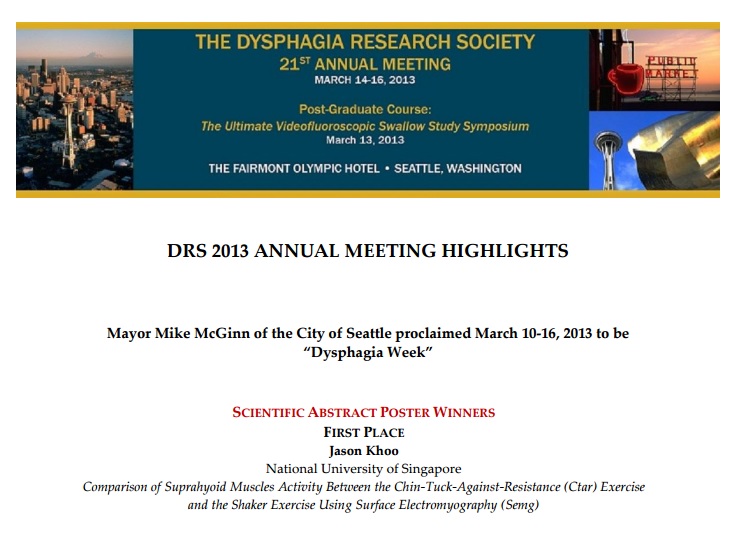
The interest on CTAR has started in Singapore long before it was announced to the world in 2013. In March 2013, Mr Jason Khoo (A MSc SLP graduate from NUS) presented the first scientific poster on CTAR at the Dysphagia Research Society Meeting at Seattle, Washington, USA in 2013. Little did we expect that CTAR actually drew so much interest at the DRS meeting and was also awarded first place for the Scientific Abstract Poster.
Some wrote in to enquire on how CTAR started?
Here is how it all begins….
The hunt for stretch ball was started in the year 2002 when I was still a junior SLP at Singapore General Hospital. I drew the inspiration from my geriatric patients who kept complaining that the Shaker’s exercise are too strenuous and they declined to perform it. After some thought, I came out with the idea of performing the chin tuck in a sitting position and conveniently use one of the stretch ball belongs to one of the patient and placed it under the patient’s chin as resistance. The geriatric patient was more willing to perform it and complaint of soreness felt at the chin area (Suprahyoid area) – that’s the sign of muscle fatigue! So I started to hunt for stretch balls on the very same night, bought at least 10 pieces. But I did not take into consideration the variation in neck length. The stretch ball was too small and hard for those with longer neck to hold it in between their chin and chest. A bigger ball was used (~10cm) and it seems to fit in nicely for most patients.
I actually prefer to use my palm to provide resistance. Why?
What about for patients who were just too weak to even initiate chin tuck with effort against the ball resistance? I noticed these patients were just resting their chin on the ball. I decided to use my palm to support the chin and found out that the effort for some of this patients were just so minimal as a result of their weakness. I did some search and found out from some dental journals indicated that the Suprahyoid muscles will only be activated when the chin is tucked down for at least 20 degrees, and the greater the degree, more suprahyoid muscle activities were noted. Also taking into consideration the principle of muscle strengthening, that for muscle to be strengthen, it has to be resisting about 60-80% of one repetition maximum. At least by using my palm I can estimate patient’s maximum effort and attempt to adjust my resistance accordingly to their effort (~60-80% of their max effort).
Outcome?
I have been performing CTAR for my patients for more than 10 years and I have seen good clinical outcomes in even severe dysphagia cases (i.e. lateral medullary syndrome).
Why I use a 12cm diameter ball in my study?
Making exercise easy and cost effective has always been my aim. The ball was chosen because it suits most neck length. Also, in research all subjects should be given the same type of resistance.
In the next coming blogs, I will be posting all the CTAR posters. Stay tuned!

 Singapore Swallowing Specialists