Dysphagia Therapy, speech therapy singapore, speech-language therapy, Swallowing Problem

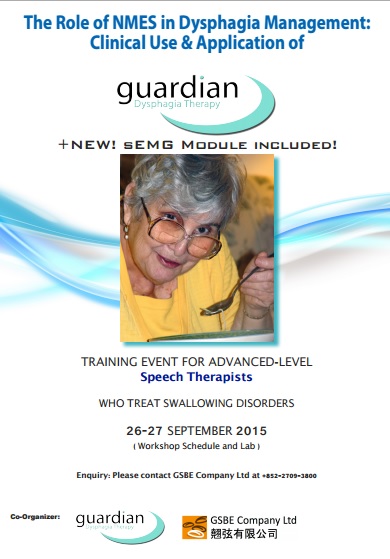
Workshop on Dysphagia Management: NMES / sEMG Guardian Way in Hong Kong

Guardian Way Workshop

Workshop on Dysphagia Management: NMES / sEMG Guardian Way

Instructors: Teresa Biber, M.S., CCC-SLP

Nancy Calamusa, MA, CCC-SLP

Date: 26-27 September 2015 (NMES / sEMG Guardian Way)

Date: 28 September 2015 (Paediatric Workshop)

Venue: Kowloon Bay International Trade and Exhibition Centre (KITEC) Room 631, Hong Kong

Contact:  GSBE Company Ltd at 9190-0180 or or GSBECOMPANYLTD@GMAIL.COM

Co-organizer: SpectraMed, Inc. and GSBE Company Ltd

Please refer to attached registration forms for details.

pdf_SEPT2015_Form

pdf_SEP2015_GuardianWay

pdf_Paed_Workshop_SEP2015

dysphagia assessment, Dysphagia Therapy, Objective assessment

Basic FEES Workshop

015

Fiberoptic Endoscopic Examination of Swallowing (Basic FEES) Workshop 2015

Hosted by The Chinese University of Hong Kong

The FEES workshops are structured to provide speech therapists and doctors with updates on dysphagia and serve to promote the use of FEES in the assessment of dysphagia, in rehabilitation planning and as a biofeedback tool. Clinical updates of dysphagia management and intervention methods will also be discussed. The workshops will also provide hands-on opportunities to participants which bridge the theory to practice. Organisers: Department of Otorhinolaryngology, Head and Neck Surgery, Faculty of Medicine, & Institute of Human Communicative Research, The Chinese University of Hong Kong Target participants: Speech Therapists, Otorhinolaryngologists and Medical Doctors.

Learning Objectives: The objectives of the 2-day workshop are to present:

 The anatomy and neurology for swallowing

 An overview of dysphagia

 Swallowing assessment – principles and the diagnostic tools

 Assessment of voice and laryngeal function

 FEES –normal vs abnormal videos

 Diagnostic options for patients – VFSS / FEES

 Tips on endoscopy

 Provide 3-4 hours of supervised hands-on practical passing the endoscope on other participant(s) and / or on dummies

Course Day:             14 & 15 December 2015 (Monday – Tuesday)

Venue:                     Prince of Wales Hospital, Shatin, Hong Kong

Registration is now opened, please go to the following link for the registration:
http://goo.gl/Ph8We8

For the details of the workshop, please kindly refer to the attached flyer or visit our website:  http://www.ihcr.cuhk.edu.hk/eng/events/main.htm

Due to the intensive nature of training, spaces are limited and processed on a first come first serve basis.

For overseas participants, you can email the secretariat for advice and special arrangements.

Applicants will be notified of the results of their application by email.
Should you need any further information, please feel free to contact the secretariat of the Program, Ms Rina To at (852) 3943 9609 or speechtherapy@ent.cuhk.edu.hk.

Dysphagia Therapy, Public awareness, Singapore, Swallowing Problem

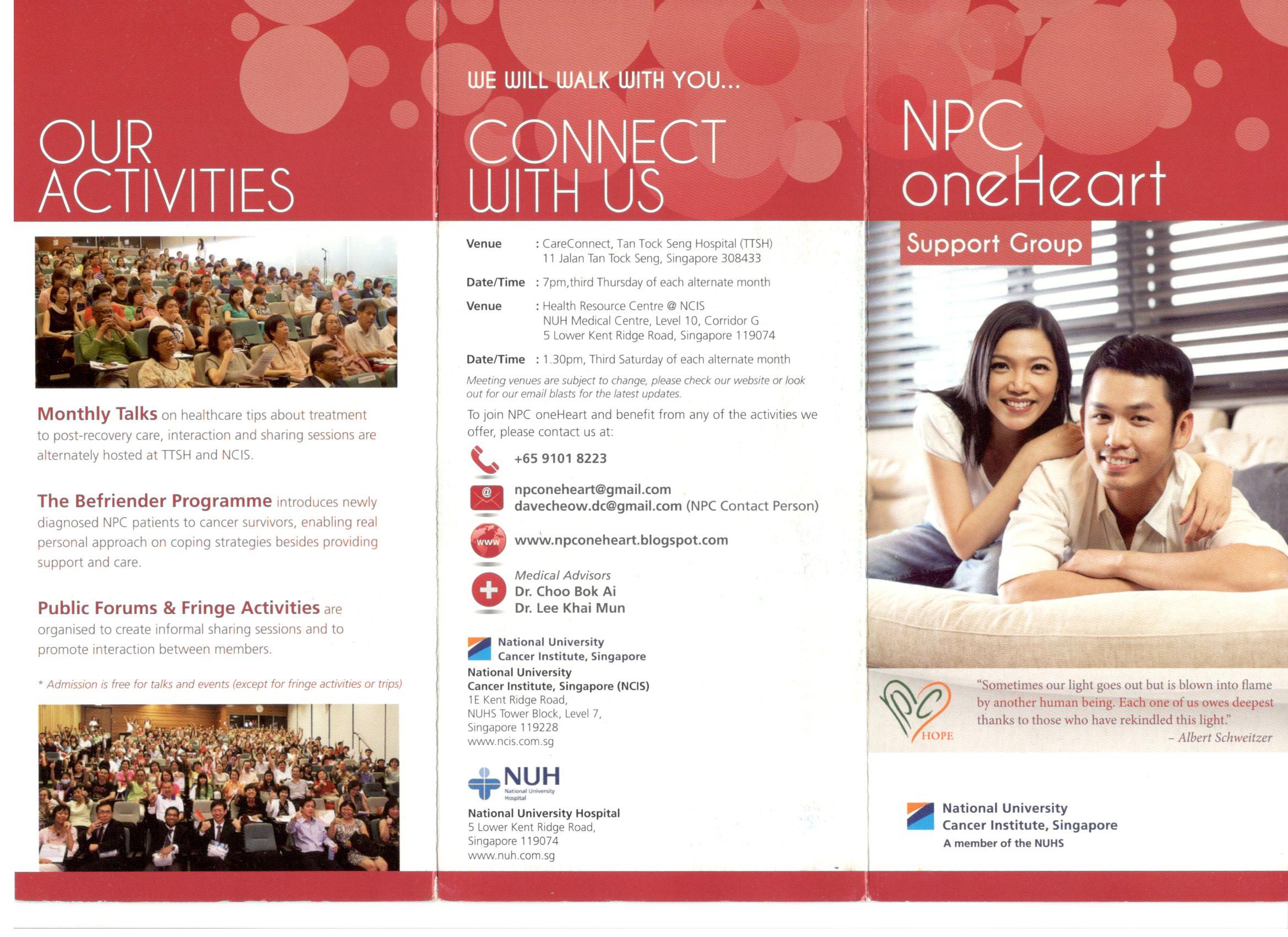
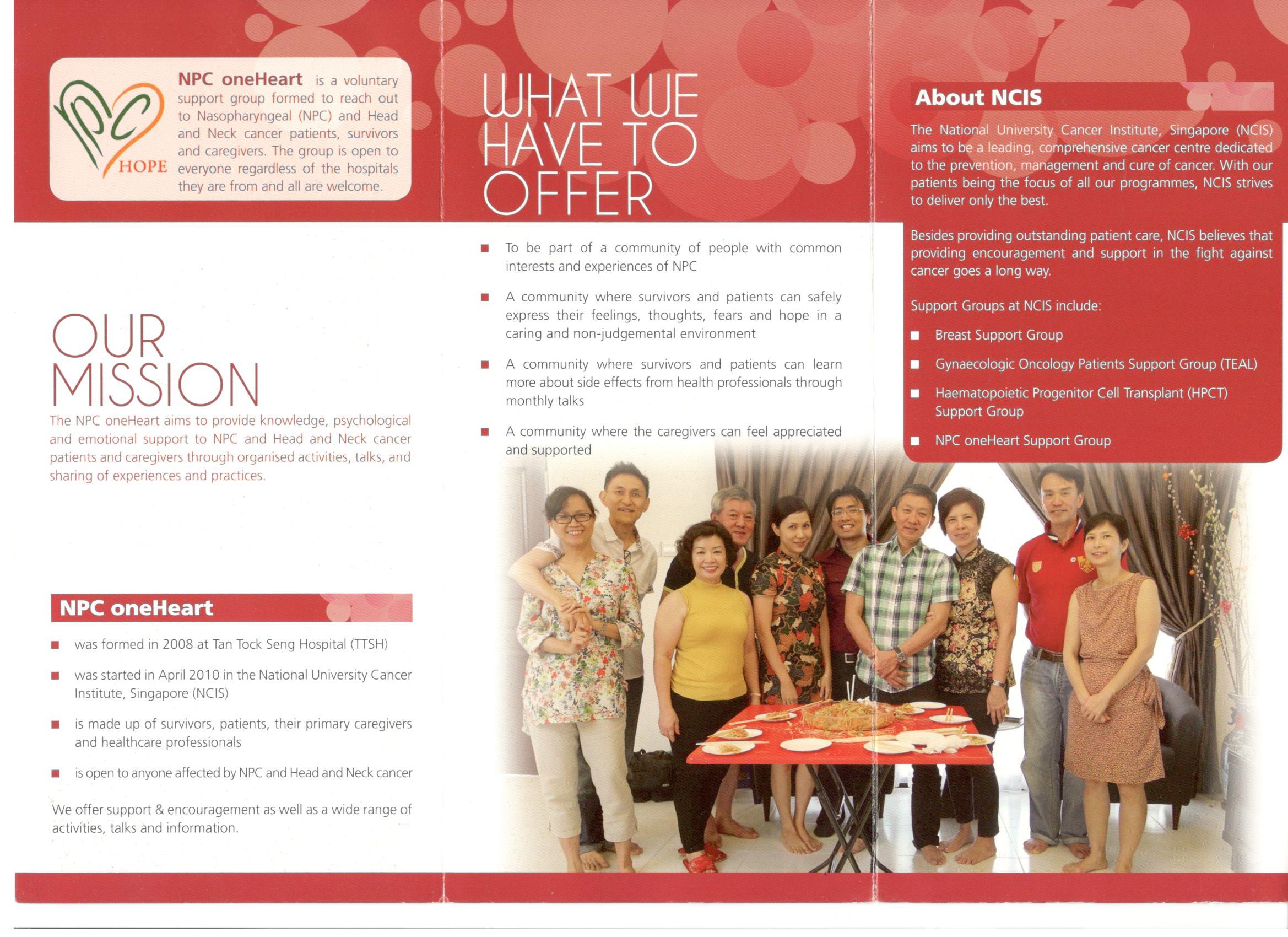
Nasopharyngeal Cancer Support Group Talk: How does NPC affect speech and swallowing?

NPC support group brochure0001NPC support group brochure0002

The Singapore Nasopharyngeal Cancer (NPC) Support Group will be organizing the above mentioned talk.

Date: 21/5/2015 (Thursday)

Venue: CareConnect, Tan Tock Seng Hospital, Singapore

This talk is open to all NPC survivors / caregivers.

Speaker: Mr Yoon Wai Lam (Director of Speech Therapy Works, Part-time lecturer in the Master in Speech Pathology Programme, National University of Singapore)

Topic: How does NPC affect speech and swallowing? Can speech and swallowing function be maintained after radiotherapy?

Speech and swallowing difficulties can occur at the time when the diagnosis of NPC is made or it can also occur during and/or after treatment. In this talk, how speech and swallowing problem happen and its management will be discussed. Simple speech and swallowing exercises that may be useful to maintain speech and swallowing function would be demonstrated during the talk.

Cost effective treatment, Dysphagia Therapy, Singapore, Swallowing Problem

Worsening dysphagia. How would you manage?

worsening of dysphagia

A comprehensive dysphagia (swallowing disorders / difficulties) management is not only limited to diet recommendation, compensatory strategies or rehab exercises. Providing crucial feedback to the medical team is equally important.

The following case is one case example:

I was consulted by my speech-language pathologist / therapist colleague regarding a case of worsening dysphagia within days in a rehabilitation hospital. The patient (pt) had a stroke (left MCA infarct) diagnosed 2 weeks ago. According to the medical report from the acute hospital, the pt presents with global aphasia and dense right hemiplegia.

Day 1:

Initial assessment revealed mild oropharyngeal dysphagia and global aphasia. Delayed swallowing initiation was suspected. Meal supervision was performed by the ST and pt was started on soft diet and thin fluids.

Day 2:

Patient’s swallowing presentation appeared to have worsen. Oral control appeared poorer, and oral residues were noted post swallow. Noted reduction in hyolaryngeal elevation and double swallows per bolus. Coughed on thin fluids. Diet was downgraded to minced diet and nectar thick fluids by teaspoon.

Day 3:

Staff nurse reported to the ST that pt is coughing on minced diet and nectar thick fluids during breakfast. On ST review, it was noted that patient presents with tongue pumping with significant amount of oral residue post swallow, delayed swallowing initiation, and multiple swallows per bolus. Wet voice was noted post swallow.

I was asked by my colleague for a second opinion.

**Before I move on to explain our plan for the case, allow me to list down the suggestions by some of the SLPs I spoke to when I presented the case to them.


1) Most SLPs would want to refer the patient for an objective assessment [Videofluoroscopy (VFS) or Fiberoptic Endoscopic Examination for Swallowing (FEES)].


2) Some would want to downgrade the diet accordingly to patient’s presentation and observe as so far no other professionals have reported any significant changes. 


3) Some would want to inform the team doctor regarding the worsening dysphagia, and to rule out the potential underlying medical complications. 

I asked my SLP colleague the following questions:

Question 1: What are the possible causes of worsening dysphagia? 

Answer: Maybe stroke, and maybe other new neurological deficits. 

Question 2: Why do you think no one else notice any other changes in status except you? 

Answer: Not sure. That’s why I am worried that I am wrong. 

My answer: Pt is dense hemiplegia (power = 0), and globally aphasia. Unlikely for anyone else to have noticed any changes functionally as both limbs and language functions are 0. 

Question 3: What would be your recommendation? 

Answer: What if I am wrong? I don’t dare to ask for a CT scan or MRI as I could be wrong and patient may end up paying for unnecessary procedure and it is not cheap.

Question 4: What if you are right?

Answer: Then the medical team can treat the pt earlier. 

Question 5: Now evaluate the pro and cons the decision “what if you are wrong?” vs “what if you are right?”. 

Answer: Ok I think it would be better to discuss with team doctor and seek their opinion on this. Will suggest further assessment to rule out new events (such as stroke / neuro issues)

After discussion with the doctor, patient was sent to the acute hospital for urgent CT scan. The new CT scan showed hemorrhagic conversion on the left MCA infarct (worsening of the stroke).

In summary, when we encounter rapid progression of dysphagia, perhaps it would be better to speak to the team doctor to find out the cause(s). Objective swallowing assessment may want to be held off until patient’s medical status is stabilized.